CRM That Knows What Your Factory Is Doing

Connect every enquiry, quotation and customer conversation with live order, production, dispatch, invoice and payment data from your ERP.

Move From the Customer Conversation to the Operation Behind It

Every customer record stays connected to the transactions that shape the relationship. Review enquiries, quotations, orders, production status, dispatches, invoices, payments, complaints and service history from one CRM. Sales and service teams get current answers without chasing production, dispatch or accounts, while management sees the complete customer picture without reconciling separate systems.
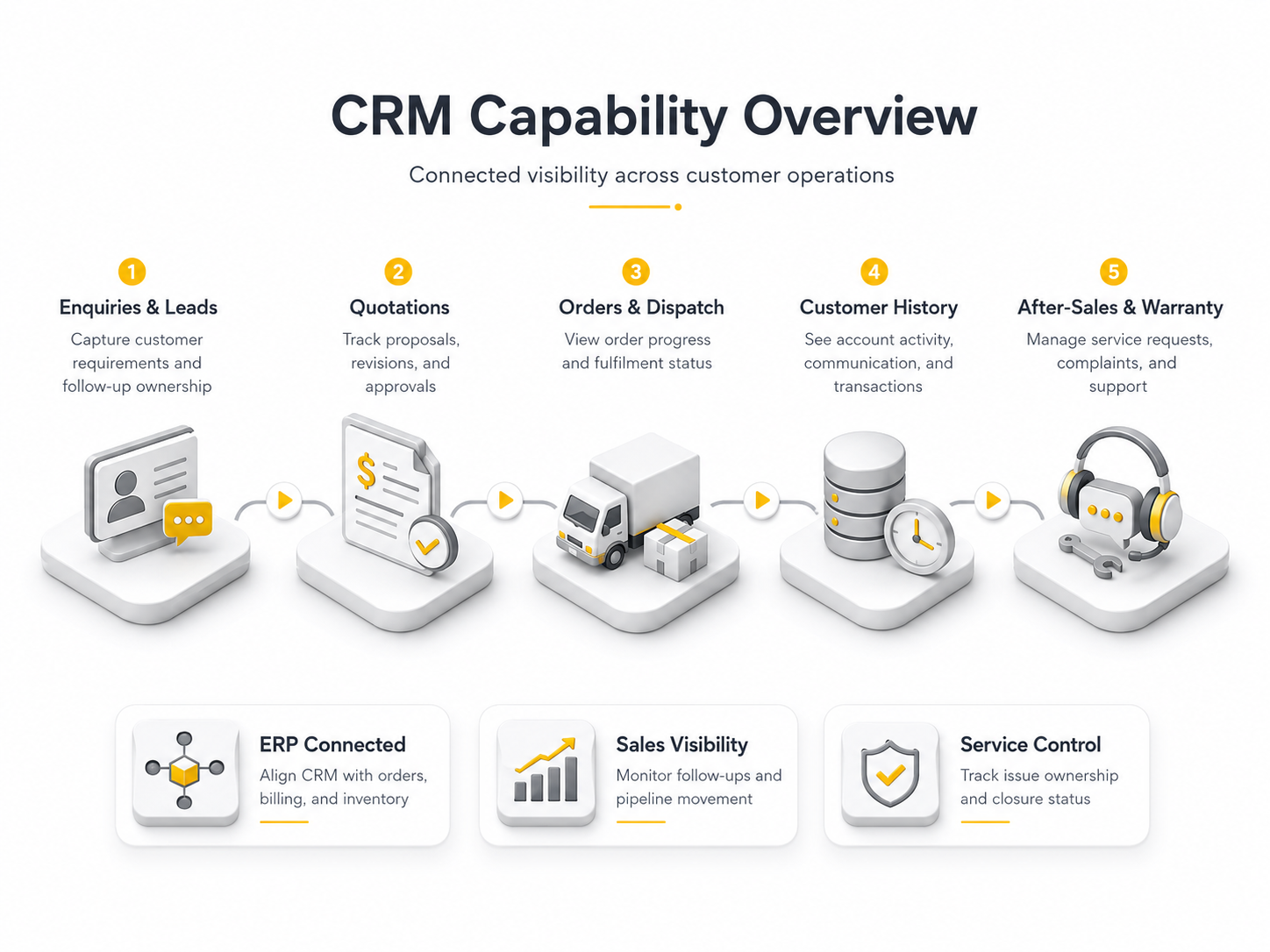
 

What Changes When CRM and ERP Share the Same Data Layer

Order Visibility

Sales teams access live order status, dispatch schedule, invoice position, and payment status directly from the customer record. Customer queries are answered on the first call rather than routed through internal follow-up.

Service Continuity

Every complaint, service request, and warranty claim is raised against the original order, with product history, delivery records, and prior service activity available in a single view. Response times improve because troubleshooting begins with full context.

Quotation Accuracy

Quotation preparation draws on production capacity, material availability, and standard costing already maintained within the ERP. Commercial commitments made to customers reflect operational reality, not estimates.

Management Reporting

Sales pipeline, follow-up activity, quotation status, order performance, and service response are consolidated into management dashboards drawn directly from live transactional data. Reports do not require reconciliation between systems.

Operational Scenarios Where ERP-Connected CRM Delivers Measurable Impact

One Customer, One Record

Structured customer records unify contact hierarchy, location, commercial terms, credit limits, and account ownership within a single authoritative reference. Sales, service, dispatch, and finance operate on the same customer data, eliminating the version-control gap that arises when customer information is maintained across departmental spreadsheets and disconnected tools.

End-to-End Enquiry Governance

Every enquiry is captured with product interest, expected value, source, and assigned owner, then tracked through defined qualification stages until closure. Follow-up cadence is enforced by workflow, and enquiries breaching defined response timelines are automatically surfaced to management. Opportunity leakage caused by manual routing or personal oversight is systematically reduced.

Controlled Quotation Lifecycle

Quotations are prepared and revised against pricing, cost, and commercial terms already maintained within the ERP, ensuring every offer reflects current operational reality. Approval hierarchies enforce discount thresholds and delivery commitments, and complete revision history is retained against each quotation for internal governance and customer traceability.

Live Order and Dispatch Intelligence

Order status, current production stage, planned dispatch date, and invoicing position are visible directly within the customer record. Sales teams respond to customer status enquiries on the first call, without dependence on manual verification from production, dispatch, or accounts. Customer-facing response quality improves without additional operational overhead.

Complaint and Warranty Handling

Complaints, service requests, and warranty claims are logged against the original order, with warranty status calculated automatically at the point of case creation. Assignment, escalation, and closure workflows enforce ownership and response timelines, ensuring service accountability is defined by the system rather than by informal follow-up.

Complete After-Sales Service History

Every service visit, spare part consumed, engineer assigned, and resolution note is retained against the product and the customer. Subsequent service cases begin with full historical context, improving diagnostic accuracy, reducing repeat visits, and giving service management the data required to identify recurring failure patterns.

Access and Data Governance

Access to customer records, commercial terms, pricing, and financial exposure is governed by user role and function. Location-wise, branch-wise, and division-wise data segregation supports multi-site and multi-entity operations. Access control is applied consistently with the wider ERP framework, ensuring security governance is unified across the platform.

Credit and Receivables Oversight

Customer-wise outstanding position, ageing analysis, and credit limit utilisation are visible to authorised users at the point of new order commitment. Credit exposure is evaluated against real receivables data rather than static customer categorisation, enabling sales and finance to make aligned decisions on order acceptance, credit extension, and collection prioritisation.

Sales Activity and Field Force Visibility

Meetings, calls, site visits, and customer interactions are captured against the account and the assigned owner, giving management continuous visibility into field activity. Territory coverage, customer engagement frequency, and executive-wise productivity are measured against live data, supporting objective performance review and targeted coaching where required.

See What Changes When Your CRM Knows What Your ERP Knows.