
Distribution & Wholesale ERP

Control inventory, pricing, credit, fulfilment and financial performance across every branch, warehouse and sales channel with IEV.

Turn Inventory Into Revenue Without Losing Margin in the Process

Wholesale performance depends on more than moving volume. The right stock must be available at the right location, every order must carry the correct price, customer credit must remain controlled and fulfilment costs must not consume the margin earned on the sale. IEV brings procurement, multi-location inventory, order management, warehouse execution, logistics and finance into one distribution ERP system, giving teams a current view of availability, commitments, fulfilment and profitability across the network.
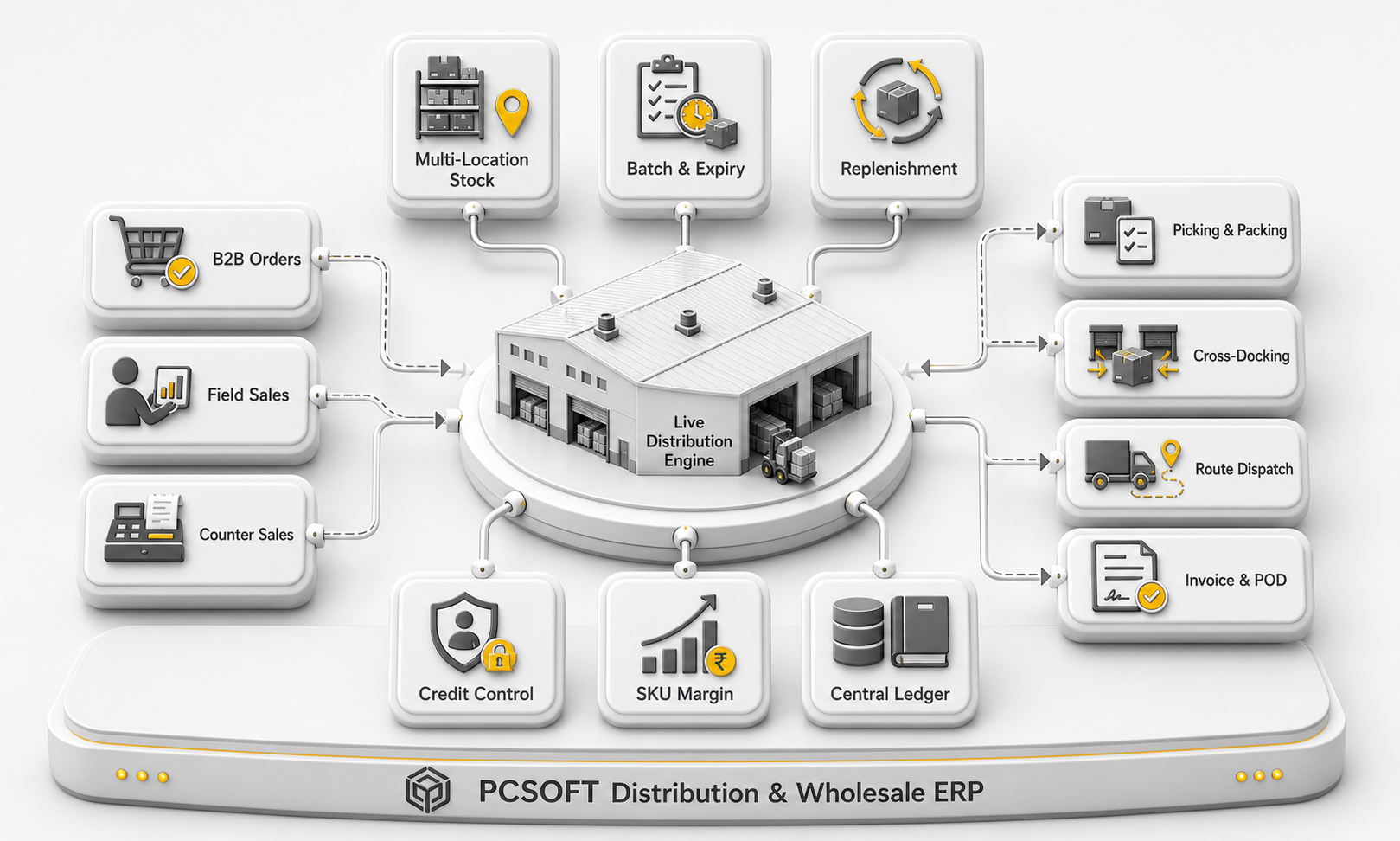

ONE CONNECTED DISTRIBUTION FLOW

Every Order Works From the Same Stock, Price and Credit Position

An order affects more than sales. It reserves inventory, changes replenishment demand, creates warehouse work, consumes customer credit, drives dispatch and becomes a financial transaction. IEV keeps these steps connected from purchase through collection, so each team works from the same operational position. Availability remains current, commercial rules remain consistent and management can follow the order’s financial effect without reconciling separate systems.

DISTRIBUTION & WHOLESALE WORKFLOWS

Follow Every Order From Requirement to Collection

Procurement & Replenishment

Buying too early locks cash into slow-moving stock. Buying too late creates missed sales, emergency purchasing and incomplete orders. Effective replenishment requires a clear view of demand, availability, commitments and supplier performance together.

IEV evaluates requirements against current inventory, open customer orders, existing purchase orders and expected supplier deliveries. Buyers can identify what must be purchased, where it is required and when it should arrive without relying on isolated branch requests or historical intuition alone.

  • Item, Warehouse and Branch-Wise Replenishment Planning
  • Stock, Commitment, Open Order and In-Transit Netting
  • Minimum, Maximum and Reorder-Level Management
  • Supplier Lead-Time and Pending-Delivery Visibility
  • Purchase Requisition, Order and Approval Control
  • Supplier Price, Delivery and Purchase-History Review

Receiving, Warehousing & Stock Movement

Inventory accuracy begins at receipt and deteriorates with every unrecorded movement. Goods waiting at the gate, placed in the wrong location or transferred without confirmation create stock that appears available in the system but cannot be found when the order is picked.

IEV controls the movement of goods from gate entry and receipt through inspection, put-away, bin transfer and inter-warehouse movement. Each transaction updates the same inventory position, giving warehouse and sales teams a dependable view of what is available and where it is located.

  • Gate Entry, Receipt, GRN and Inspection Processing
  • Warehouse, Zone, Rack and Bin-Wise Stock Visibility
  • Barcode and QR-Assisted Inventory Transactions
  • Inter-Warehouse, Branch and Depot Transfer Control
  • Batch, Lot, Serial and Expiry-Date Tracking
  • Physical Stock Count and Inventory Adjustment Management

Order, Pricing & Credit Management

Wholesale orders may enter through sales teams, counters, branches or digital channels, but each must use the same inventory, pricing and customer controls. Inconsistent order processing creates overselling, discount leakage and avoidable credit exposure.

IEV validates product availability, customer terms, applicable pricing and credit position as the order is processed. Sales teams can confirm what can be supplied, at what commercial value and whether the transaction is ready for fulfilment before promising it to the customer.

  • Multi-Channel Sales Order Capture
  • Customer, Item, Quantity and Date-Based Pricing
  • Discount, Scheme and Promotional-Term Application
  • Available-to-Promise and Inventory Allocation
  • Credit Limit, Outstanding and Overdue Invoice Validation
  • Order Hold, Approval, Release and Amendment Control

Picking, Dispatch & Delivery

A confirmed order is not complete until the right items, quantities and batches reach the customer with accurate documentation. Manual handovers between sales, warehouse and transport teams create picking errors, delayed loading and freight that is difficult to reconcile.

IEV converts released orders into controlled fulfilment work. Warehouse teams can allocate, pick and pack against approved demand, while dispatch teams consolidate deliveries by route, vehicle or transporter and maintain visibility through final proof of delivery.

  • Order-Wise Allocation, Pick List and Packing Control
  • Batch, Serial and Expiry-Based Item Selection
  • Route, Vehicle and Transporter-Wise Dispatch Planning
  • Delivery Note, Invoice and E-Way Bill Processing
  • Shipment, Delivery and Proof-of-Delivery Tracking
  • Freight, Short Delivery and Transporter Claim Recording

Returns, Claims & Margin Control

The commercial result of an order may change after dispatch through customer returns, pricing disputes, scheme claims, freight deductions or supplier rebates. When these adjustments are managed outside the ERP, reported margin remains higher than the profit the business actually retains.

IEV keeps post-sale and post-purchase adjustments connected to the original item, customer, supplier and transaction. Finance can settle claims with supporting history, while management can evaluate net profitability across products, accounts, routes and territories.

  • Sales Return, Rejection and Replacement Processing
  • Customer Claim, Debit Note and Credit Note Management
  • Supplier Rebate and Purchase-Scheme Tracking
  • Freight and Delivery-Cost Allocation
  • Item, Customer, Territory and Salesperson Margin Analysis
  • Gross Margin to Net Contribution Visibility

BUILT FOR DISTRIBUTION OPERATIONS

Control Every Decision Between Purchase and Delivery

Available-to-Promise Inventory Tracking

Monitor physical, committed, available, and in-transit inventory across every warehouse, branch, and depot. The system strictly separates stock on hand from stock already promised to customers, helping sales teams confirm realistic availability. This prevents the exact same inventory from being committed through multiple sales channels and protects your sales commitments.

Automated Pricing & Discount Rules

Manage customer rates, quantity breaks, product groups, promotional terms, and date-based pricing through strictly controlled commercial rules. The correct price and discount structure automatically follows the transaction to eliminate manual intervention. This instantly protects your revenue margin across branches, retail counters, field sales teams, and individual customer accounts.

Order-Level Credit Limit Control

Evaluate customer credit limits, outstanding balances, overdue invoices, and total order exposure directly before releasing any goods. Giving sales and finance the exact same customer position allows genuine exceptions to be approved deliberately. This prevents finance teams from discovering excessive commercial exposure after the physical delivery has already been completed.

Demand-Driven Procurement Planning

Compare actual sales demand, current stock positions, open orders, supplier lead times, and minimum inventory requirements before purchasing. Buyers can accurately focus working capital exclusively on products that require immediate replenishment. This eliminates preventable stock-outs and stops excess inventory accumulating through disconnected, assumption-led buying decisions.

Multi-Warehouse Stock Movement Tracking

Track material receipt, inspection, put-away, transfer, allocation, picking, packing, and final dispatch across your entire warehouse network. Critical batch, lot, serial, and expiry information remains permanently attached to the material wherever relevant. This strict tracking preserves inventory accuracy as goods move between physical locations and through different fulfilment routes.

Post-Delivery Net Margin Analysis

Bring purchase costs, selling prices, applied discounts, promotional schemes, freight, claims, and returns into one unified commercial ledger. Management can accurately review the true financial contribution of every item, customer, salesperson, route, and territory. This allows you to measure actual business profitability instead of judging performance through gross sales value alone.

Bring Every Order, Warehouse and Margin Into View