Plastic & Rubber Moulding

Plan machines and moulds, control material consumption, monitor process output and trace actual cost from resin issue to accepted part.

Your Margin Is Hiding in Shot Weight, Cycle Time and Scrap

A moulding plant can hit its production quantity and still miss its margin. A few extra grams in every shot, longer-than-standard cycles, repeated colour changes, worn cavities and regrind used without control accumulate across thousands of parts. IEV brings material, tooling, machine scheduling, production, quality, inventory and costing onto one system. Instead of learning about the loss after month-end, teams can see which run, machine, mould or material variance created it.

THE CONNECTED FACTORY

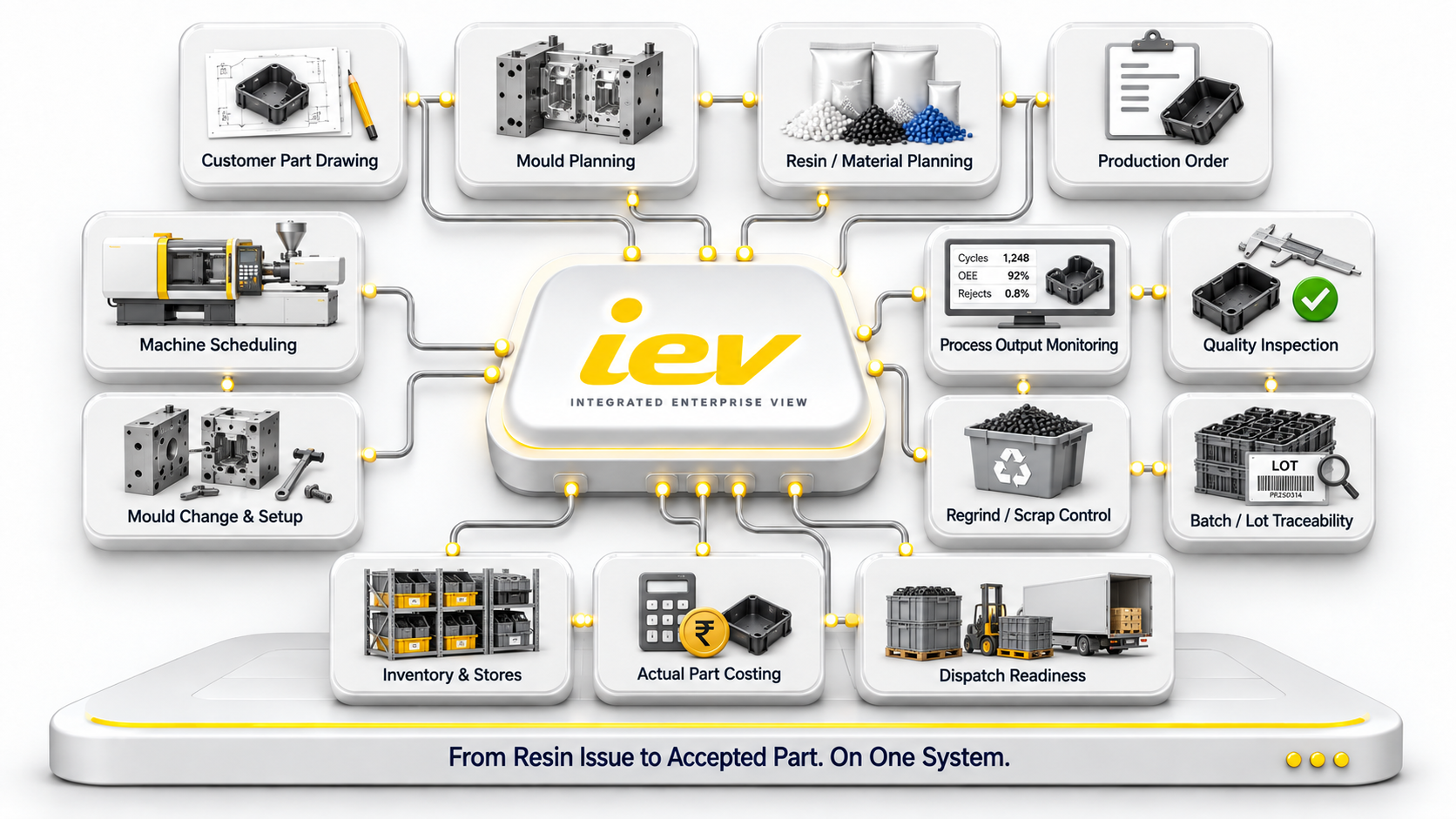
The Production Run Should Tell the Whole Story

A customer order determines the product, quantity and delivery date. The product determines the material recipe, mould, machine and approved process conditions. Production creates good parts, scrap, rework and regrind, while inspection decides what can enter finished stock. IEV keeps these events within one production record. Stores can see what was consumed, planners can see what was completed, quality can see why parts failed and finance can see the cost of the accepted quantity without rebuilding the run from separate registers.

PLASTIC & RUBBER MOULDING WORKFLOWS

From Material Requirement to Accepted Part

Order Planning & Run Scheduling

Scheduling moulding work involves more than finding an idle machine. The selected press must support the tool, tonnage and process; the correct material and colour must be ready; the mould must be available; and the sequence must avoid unnecessary cleaning and changeovers.

IEV converts customer demand into production requirements and brings machine, mould and material readiness into the scheduling decision. Planners can arrange runs around real constraints while keeping due dates, setup time and the effect on other orders visible.

  • Customer, Product, Quantity and Delivery-Date-Wise Demand
  • Machine Capacity, Tonnage and Process Compatibility
  • Mould, Die and Tool Availability Checks
  • Material Grade and Colour-Based Run Sequencing
  • Setup, Cleaning and Changeover-Time Consideration
  • Production Completion Against Dispatch Commitments

Material Preparation & Dosing

The production result begins before material reaches the hopper, mixer or extruder. Incorrect drying, uncontrolled additives, inaccurate masterbatch ratios or excess regrind can change appearance, strength, dimensional stability and the economics of the entire run.

IEV translates the approved material structure into production-order requirements. Virgin polymer, rubber compound, masterbatch, additives and regrind can be issued against the run, preserving lot traceability and allowing planned consumption to be compared with what the machine actually used.

  • Approved Material Recipe and Revision Management
  • Polymer, Compound, Masterbatch and Additive Requirements
  • Material Lot and Batch-Controlled Issue
  • Drying and Pre-Processing Requirement Recording
  • Regrind Source, Stock and Permitted Percentage Control
  • Planned Versus Actual Material Consumption

Mould, Die & Machine Setup

A machine may be free while the production order remains unready. The mould could be under repair, a cavity may have been blocked during the previous run or the chosen press may not suit the tool dimensions and required clamping force.

IEV places tool condition and machine compatibility inside the preparation workflow. Production teams can verify availability, record issue and setup, identify active cavities and confirm readiness before the order begins consuming floor time and material.

  • Mould, Die, Insert and Cavity Identification
  • Tool Storage, Issue, Return and Availability
  • Machine-to-Tool Compatibility Verification
  • Shot Count and Cumulative Usage Recording
  • Cavity Status, Blockage and Repair History
  • Setup, Trial Run and Production-Release Control

Moulding, Extrusion & Cure Execution

Once the run begins, output must be evaluated alongside the conditions under which it was produced. A higher quantity means little if longer cycles, unstable temperatures, repeated stoppages or process deviation create excess consumption and poor first-pass yield.

IEV records production progress by machine, shift, tool and operation. Good output, rejection, rework, downtime and actual consumption remain attached to the run, allowing supervisors to compare planned performance with what occurred on the floor.

  • Injection, Blow, Compression and Transfer Moulding Booking
  • Plastic and Rubber Extrusion Progress Tracking
  • Cycle, Temperature, Pressure and Cure Records
  • Machine, Shift, Operator and Tool-Wise Output
  • Rejection, Rework, Downtime and Process-Loss Capture
  • Planned Versus Actual Cycle, Output and Yield

Inspection, Traceability & Cost Closure

The run is not commercially complete when the machine stops. Parts still require inspection, rejected quantities must be separated, rework must be recorded and accepted output must retain its connection to the material, tool and process history that produced it.

IEV brings quality release, traceability and cost closure into the same workflow. Teams can investigate defects by material lot, machine, mould, cavity or shift, move only approved quantities into finished stock and calculate cost against the parts that can actually be sold.

  • Incoming, In-Process and Final Inspection
  • Dimensional, Visual and Physical Test Results
  • Defect, Rejection, Rework and Cause Classification
  • Material Lot-to-Finished Batch Traceability
  • Mould, Cavity, Machine and Shift-Wise Quality Analysis
  • Accepted Quantity, Scrap and Actual Part-Cost Review

BUILT FOR PLASTIC & RUBBER OPERATIONS

What Better Moulding Control Delivers

Polymer & Regrind Consumption Tracking

Compare planned material requirements directly against actual polymer, compound, masterbatch, additive, and regrind consumption for every single run. Production teams can identify excess usage early and immediately correct dosing variances. Strict consumption tracking reduces the raw-material cost carried by each accepted part, directly protecting your bottom-line profit margins.

First-Pass Yield & Defect Isolation

Connect exact process conditions, material lots, machines, moulds, and individual cavities directly with the quality result they produced. Recurring defects become significantly easier to isolate, helping production teams rapidly correct the exact source of rejection. This permanently increases the proportion of output that passes inspection the first time, maximising your saleable inventory.

Mould, Die & Shot Count Management

Track exact shot counts, cavity conditions, repairs, and complete maintenance history for every single mould and die. Maintenance schedules can be reliably planned around actual factory usage, drastically reducing unexpected tool failures. This protects dimensional consistency and avoids costly production disruptions caused by tooling that was not ready for the next scheduled run.

Machine Sequencing & Changeover Control

Sequence production runs precisely around material grade, colour, mould availability, machine compatibility, and strict customer priority. Better run planning drastically reduces unnecessary machine cleaning, excessive tool changes, and wasted setup time. This allows a much higher percentage of your available machine hours to generate saleable output, directly driving top-line sales revenue.

End-to-End Lot & Regrind Traceability

Preserve the exact relationship between incoming material lots, specific regrind sources, production runs, and finished product batches. Quality teams can instantly identify affected output, respond to customer enquiries with hard evidence, and execute rapid containment. This isolates issues quickly without placing unrelated production on hold or risking your ongoing sales contracts.

True Part Costing & Margin Analysis

Calculate exact financial costs strictly against accepted output after material usage, cycle time, rejection, rework, and downtime have been fully accounted for. Management gains a factual, clear view of which specific products, machines, and production runs are meeting expectations. This highlights exactly where commercial or operational corrections are required to protect your margins.

Get One Operational View of Your Moulding Plant